


For many students who are enrolled in IGNOU reviewing literature can be the most elusive portion of their work. This is especially true for those working on an ignou mcom project, where academic rigor is expected. However, instruction often isn't available. Students typically ask if they should summarize their books, revise journal articles, or simply collect quotes. The reality is somewhere between, and knowing how different approaches can impact the overall quality of the project.
A literature review is not written to show the amount of material you've read. It's written to demonstrate how well you understand the previous work that pertains to your subject and how your project is a part of it. IGNOU assessment experts are attuned to this chapter, as it illustrates your ability to connect theoretical concepts to research direction.
Understanding the Purpose of Review of Literature
Before completing any work, it is important to understand why this chapter is needed in an ignou MCOM project. The review of literature serves three main functions.
First, it shows that the subject you picked was studied before and has relevance to academic research. Second, it helps you identify gaps or limitations in previous studies. Thirdly, it serves as an outline for your research objectives as well as your method of study.
A lot of students view this chapter as a formality and copy content from their previous projects or sources on the internet. This usually leads to the project being rejected or not getting marks. IGNOU requires original work even when discussing studies that are already in progress.
What IGNOU Expects in Literature Review
IGNOU does not require students to write at the level of the PhD thesis. At the same time those who write merely to explain their ideas are being discouraged. If you are working on an ignou-mcom project, the review of literature should reflect postgraduate level understanding.
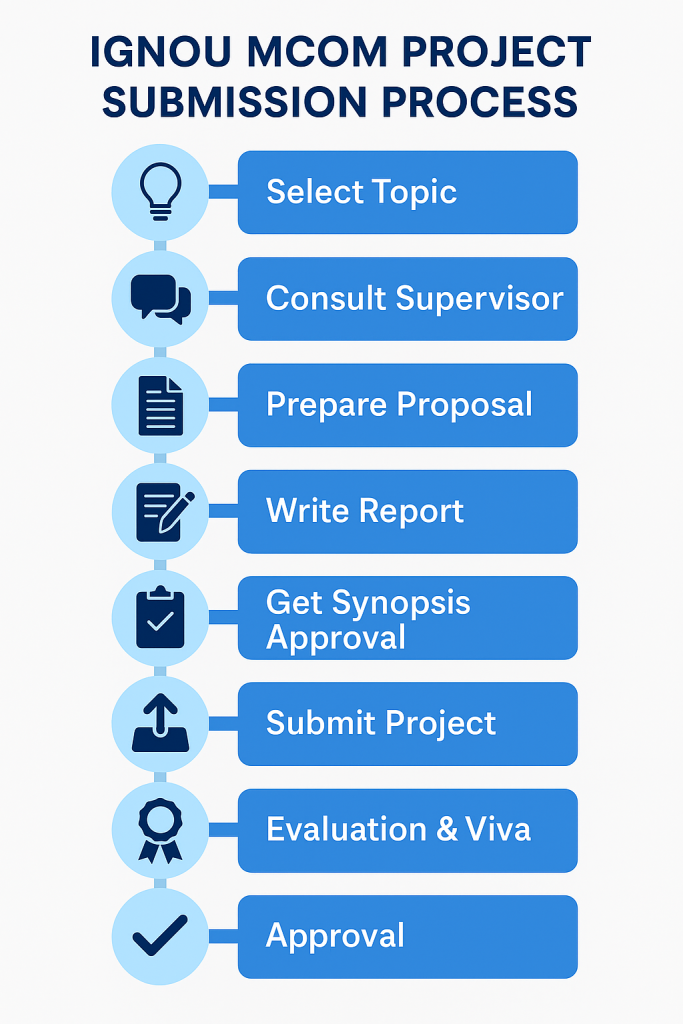
The expectation is to look over books, research papers Journals, reports, and sometimes government publications related to your area of study. The concentrate should be on studies which directly relate to your research field.
As an example, if the project focuses on the performance of financials of banks and banks, then your literature search should be focused on previous studies about financial ratios efficiency of banks, profitability analyses and risk evaluation.
Selecting Relevant Literature Sources
The most frequent mistake that students make is selecting too many unrelated sources. Quality is more important than quantity. When it comes to an ignou mcom project in the range of 15 to 20 high-quality sources are often enough If they're chosen with care.
Some good sources are academic journals well-known books written by renowned authors RBI newspapers, report from government agencies, as well as university research papers. Websites that don't have a clear authorship must be avoided.
The best studies are those that are current which are typically from the last 10 years. It is possible to include older studies in the event that they are fundamental in the nature.
Organizing the Review of Literature Chapter
A well-organized chapter increases understanding and perception. Instead of writing brief summaries on the fly, separate each literature overview into clear sections.
You may organize the chapter according to themes, time period techniques, methodologies, or variables examined. For instance, one chapter may examine studies that pertain to the financial performance, while another may focus on liquidity while the other on operational efficiency.
This structure assists evaluators to understand that you're not simply copying content but analyzing it.
Writing Style for IGNOU Literature Review
The writing style should be straightforward but academic. Avoid dense language and excessive use of jargon. IGNOU seeks simplicity above all else.
Every research you share should contain the name of author, year of study, purpose, method, and main findings. It is not necessary to list the findings in a way that is purely mechanical. Make sure to connect one study to another.
For instance, when discussing one study, you may be able to mention that another author's findings backed or disputed those findings. This comparative approach adds depth to your ignou MCOM project.
Avoiding Common Writing Mistakes
One of the most frequent mistakes is to write the literature review as an academic chapter. It is important to clarify the basic concepts, such as the definition of accounting, or the meaning of management do not belong here unless directly linked to previous studies.
Another mistake is to use too many quotes. Your review of literature should be written in an individual way. Paraphrasing shows understanding, while copying shows dependency.
Students may also not link studies to their own research topics. Each study you reference should be clearly connected to your objectives for your project.
Linking Literature Review with Research Gap
One of important outcomes of a review of literature is to identify the gap in research. IGNOU examiners are expecting you to clarify what research earlier researchers did not or where further study is required.
After examining a variety of studies, you'll notice that the majority of studies focus on large organisations, while small firms were left out. The earlier studies also used secondary data but primary information was scarce.
This gap is the basis for your Ingou MCOM project. Without it, your project may appear repetitive.
Use of Citations and Referencing
While writing a review for literature an appropriate citation is required. IGNOU generally recognizes APA style, however the consistency is more important than perfection.
Each study must be mentioned in the list of references at the end of the study. Lack of references could raise doubts over authenticity.
Avoid footnotes when reviewing literature. The in-text citation is better and appears cleaner in an ignou MCOM project.
Length of Review of Literature Chapter
Students often inquire about how long the review of literature must run. There is no fixed rule and for an ignou MCOM project, the chapter generally runs between fifteen hundred between two thousand and a thousand words.
The length should depend on the level of complexity of the topic. A topic that is more extensive requires greater research, whereas a more narrowly-focused topic requires fewer but deeper discussions.
Writing excessively long reviews without analysis is not going to improve your marks.
Example of Literature Review Writing Approach
Instead of writing this way,
Author A did a thorough study of the performance of banks and came up with positive results
Write this in the same way as
Author A conducted a research study on the performance of banks using financial ratios. They concluded that profitability increased because of improved asset management. This conclusion was later affirmed by Author B He emphasized the role played by the efficiency of operations in enhancing returns to banks.
This approach reflects the ability to analyze and comprehend, which is appreciated in an mcom project.
Maintaining Originality and Academic Integrity
IGNOU is a firm believer in plagiarism. Many projects get blocked or rejected because of plagiarism in literature reviews. Even if the reference is to prior studies, the language will have to match your own.
Use plagiarism detection tools if possible, and modify content until it sounds natural. A sentence that is slightly imperfect is more effective than perfect copying.
Final Review Before Submission
Before submitting an ignou MCOM project work IGNOU (www.mexicorent.com.mx) assignment, you should read the literature review thoroughly. Find out if the study you are reviewing is relevant, whether the flow of the study is coherent, and whether your chapter will naturally lead to your research goals.
Ask yourself one simple question. Does this chapter explain the reasons why my study is required. If yes, then it's on the right path.
Closing Thoughts
Reviewing literature for an ignou mcom project can be a challenge at first particularly for students returning into academics after a time off. If you can realize that it is focused on connection and analysis rather than memorization, the task becomes manageable.
Take time to read, consider, and write in your unique voice. Your effort is evident in the final draft and often determines the difference between the average submission and a powerful one.